

Dad The Builder
If someone were to ask me to describe my father in one word, without hesitation my answer would be “cars.” Some of my earliest and fondest memories are from attending car shows during the summers with my dad. I oozed with pride rolling into the fairgrounds, arm dangling out of the passenger side window of his ’34 Plymouth. Or breezing down the highway in his ’66 Chevelle, watching people break their necks trying to get a closer look. He’s a body man by trade, having spent most of his career fixing up dinged doors and fender benders. But his secret sauce is in the paint. A true artist, whether it’s a set of flames on a Harley or a wicked coat of candy on the latest classic to roll out of his booth.
A self-made man with his own shop, he’s where I first learned about hard work and dedication. And what better teaching tool could a father give his son than his own build. I had just turned 14 when my dad led me into the garage to unveil my birthday gift. A dusty, beaten down pile of steel with no engine, 4 flat tires, and half of the front end missing. It took me a moment to realize what I was looking at, but then I saw it: the indentation on the quarter panel where the chrome louver would sit. I was staring down at a 1969 Chevrolet Camaro, my 1969 Camaro. I remained speechless as I gazed at this blank canvas, mouth agape, fantasizing of the possibilities.
Every day after school, I can remember getting off the bus and heading straight for the garage. I would remove every nut and bolt that my strength could muster, cataloging each item as if I were disassembling an Erector Set. Then came the real work; the blood, sweat, tears and patience that made me really appreciate what my father did for a living. Hours upon hours of stripping, sanding, straightening, and aligning. We would attend swap meets in search of original parts, but opt for more modern upgrades when it came to the chassis.
Ultimately, the build would be put on hold while I went off to college. Of course, there were still summers and holiday trips home when I would continue to tinker. But there was some serious cash needed to execute the next phase, namely the interior and a brand new engine. And I was already financing my way through college. Around this time my dad had just finished a ’37 Ford he had been working on. The first show he attended to showcase his newest creation was at Goodguys in Columbus, OH. A guy from Texas with a heavy wallet happened to pass by and gave my dad an offer he could not refuse. He returned home without the Ford, but enough cash to finance his next two builds, including the completion of our six-year project. And boy, he did not disappoint.

Built To Drive
Stance, wheeltubs, and big rubber suggest a would-be pavement destroyer. Yes, it has an LS transplant, but the engine is stock. Where you’d expect a clutch pedal, there is none. A single swoopy custom-made throttle and brake pedal are found underneath the dashboard. And while the exterior is pin-neat, arrow-straight, and captures some delightfully subtle, handcrafted cues, the interior is all-out berserko. Lots of leather, metalwork, and sweat equity. As luscious as the car is on the outside, the candy is wrapped in a totally wicked interior pod. There is something to be said for a modest, stylish coat covering a completely unsuspected cockpit that leaves you with a lasting imprint. Some parts of it look tempting, almost good enough to eat.
Creature comforts and a pleasant driving environment are revered here, more practicality and accommodation than anything the factory could envision. So in a world of want-to-be’s, in a world helpless not to embrace the “hot” item of the week, in this world of too many following the pack, we simply built a car for all seasons. If memory serves, this is how it was in the beginning. Each person built his car as an expression of himself for himself, not a slavish replicant of the popular notion to which the rest of the pack is clinging.
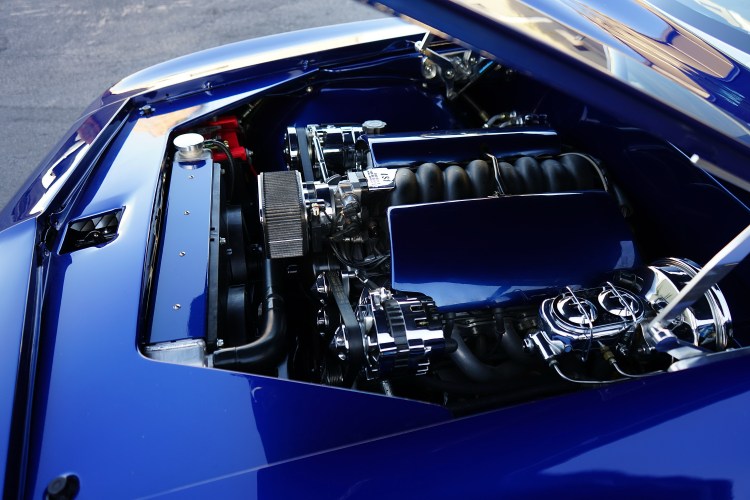
Engine & Drivetrain
Fifteen years ago, you couldn’t give an LS engine away. Now, they are the darlings of the sport. GM provided the 5.7-liter straight off the assembly line, and we dolled up the exterior. With 350 hp and 365 lb-ft of grunt, the motor is strong and flexible enough to satisfy the power proclivities, yet docile enough to be driven anywhere on the worst pump gas. Instead of that expected stick-shift, we posted a beefed 4L60E automatic with a 2,300-stall converter behind the modest LS1. A custom-length prop shaft transfers grunt to the re-bopped 12-bolt carrying a Positraction differential and 3.73:1 gears. Against that 0.70:1 top gear in the 4L60E, this thing bombs the boulevard with a breezy 2.61:1 final drive.
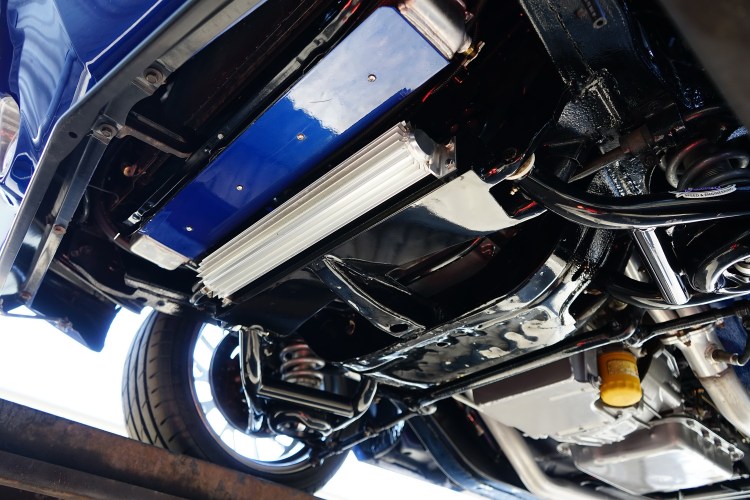
Chassis
The chassis has been fortified with Detroit Speed products. The DSE subframe contains all the mechanicals and dynamics, seemingly programmed into the construction. That would include coilover shock absorbers, tubular control arms, and rack steering. We retained the leaf spring rear suspension but hung it with offset shackles to clear the tires and the mini-tubs. We ran subframe connectors and set the stance.
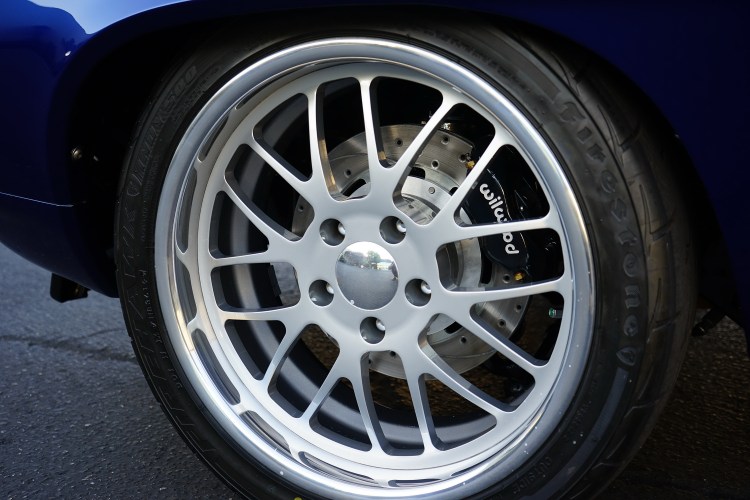
Wheels & Brakes
These props are the most important visual cues of any car. Here we have a fine blend of Boze Pro Touring Satin forgings, 18×8 and 19×12, paired with 245/40 and 285/35 Firestone Firehawk Indy 500 asymmetrical rollers. The chopper grinds down on 13-inch Wilwood discs.
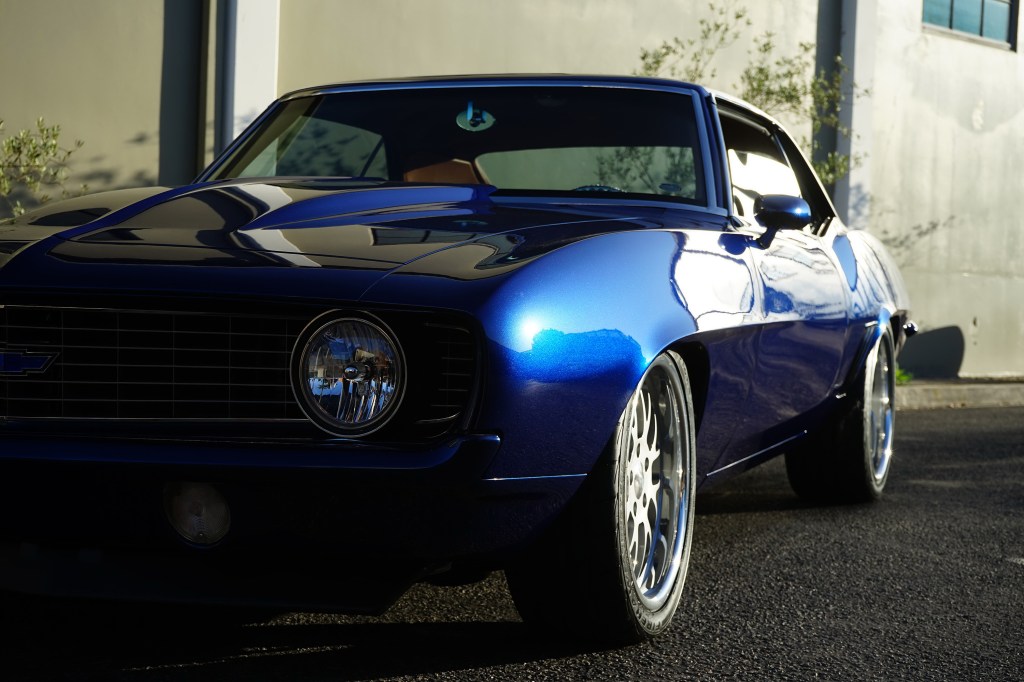
Body & Paint
The most sanitary sheetmetal was swabbed of its door handles, acquired a custom trunk lid, a reformed rear bumper, a lowered spoiler, and LED taillights. The only departure from smooth and straight is the ZL2 cowl hood. Color Craft pronounced this as the perfect recipient of Sikkens blue and clear coats.
Interior
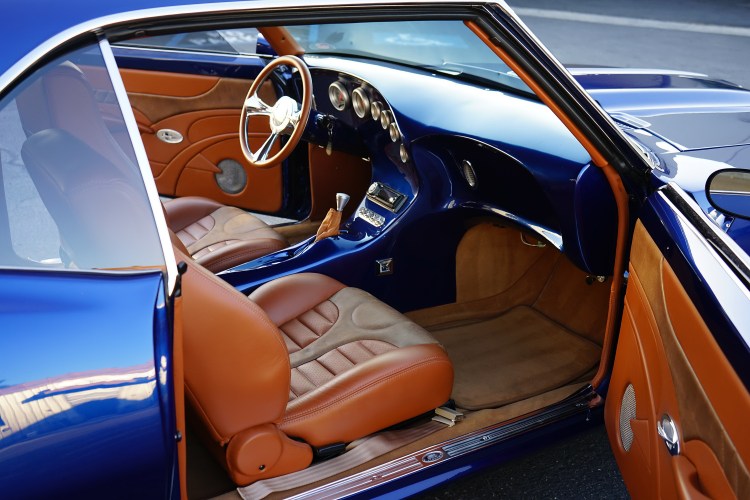
Though the familiarity of the ubiquitous ’69 Camaro is unchangeable, we wanted an interior that departed from the usual, a moon-shot original, a pod totally separate from the rest of the project, a wonderful blend of whimsy and practicality. Looking way too sumptuous for a track beater, we used shades and textures of tan and brown leather. Downs Industries provided the wraparound fiberglass dashboard, mimicking the coves indigenous to early-model Corvettes.
All the accessory knobs and control handles are logically arranged, quite within fingertip range, and can be manipulated via peripheral vision. The scheme was underwritten with a Painless wiring loom and the all-important Vintage Air HVAC system. A Billet Specialties Stiletto steering wheel mates with a tilt column. Other additions include AutoMeter gauges, a leather-wrapped Lokar shifter, and electric window lift switches on the side of the custom-built console.
Audio looms large. A Critical Mass 1,000-watt amp head, a 10-inch subwoofer, two 6×9-inch speakers, and 6-inch speakers in the door panels.

A New Chapter
Nearly twenty years and 8,100 miles later, the time has come to start anew. The boys at D&S Tire in Costa Mesa recently tuned her up to prepare for the sale. They rebuilt the master cylinder, flushed the brake fluid, replaced the radiator, replaced the power steering hose, flushed the power steering system, rebalanced the driveshaft, replaced the pinion seal and transmission output shaft seal, replaced worn hose clamps, resealed all coolant hoses, and replaced the differential cover. They also installed 4 brand new tires. The vehicle is now being stored at Doctor Detail in Costa Mesa while she waits for a new home.
While there’s certainly a load of sentimental value attached to this build, we’re ready to write the next chapter. A challenge to yet again push the limits of our imaginations, just as we did more than a decade ago.
 Steve's 1969 Camaro